
Welcome soaking for parched parts of central and eastern Qld
Significant rainfall totals have already been recorded in parts of Queensland which have seen very little rainfall since early autumn, and more wet weather is set to arrive in coming days.
This wet spell will be welcomed by many Queenslanders. As the chart below shows, Queensland had Australia's largest area of significantly below-average rainfall in the 2026 winter, partly due to the influence of El Niño, which typically makes the state drier.
While outback Queensland saw some unusually wet weather in both June and July, the eastern half of the state had a relentlessly dry winter, and the trend has continued through the first half of spring in many areas.
Until this week.
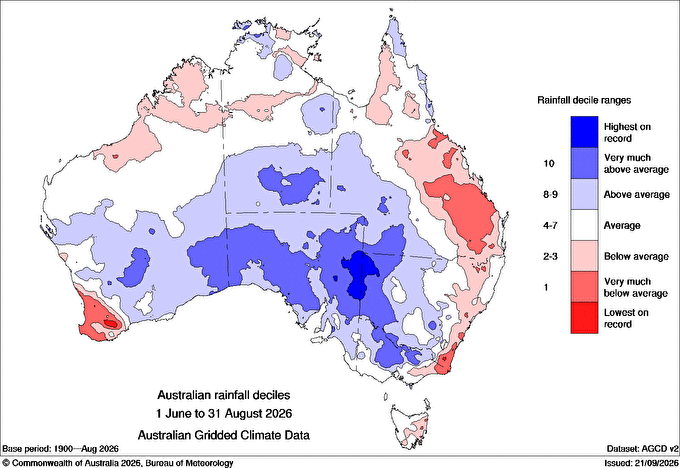
Image: Australian rainfall deciles in winter 2026. Source: BoM.

Where has the rain already fallen and where will it fall?
In the 24 hours to 9 am this Thursday, October 15, widespread falls of 25-50 mm were reported from the Gulf Country in the state's northwest all the way down to parts of the state's southeast.
At least two locations in the Gulf Country recorded more than 50 mm, while falls exceeding 50 mm extended all the way east to the Central Highlands and Coalfields forecast district.
A weather station close to the town of Emerald recorded 61 mm in the 24 hours to 9 am Thursday, while Emerald itself had 19.2 mm in the same period.
That's far from a huge total, but it's a significant soaking when you consider that Emerald had just 1 mm of rainfall in June, no rain in July, 1 mm in August and absolutely no rain again in September, followed by just a few millimetres this October before yesterday's rainfall.
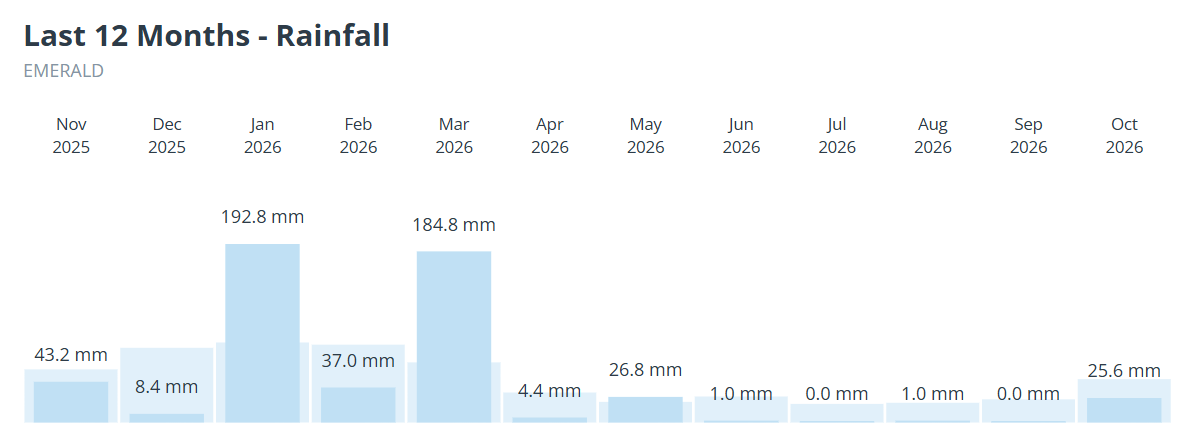
Image: Accumulated rainfall (sky blue) vs average rainfall (light blue) in the 12 months to October 2026 in Emerald, Qld. Source: Weatherzone.
The situation was similar in the nearby Coalfields town of Moranbah, where the 12 mm that fell to 9 am and the additional 20 mm of rainfall that accumulated between 9 am and 1 pm this Thursday (AEST) would have been extremely welcome after just 10.6 mm of rainfall was recorded in the six months from March to September.
While late autumn, winter, and early spring is typically the driest time of year in much of eastern and central Queensland, this year's paltry rainfall totals were still well below the historical average.
An important point worth noting is that despite the widespread nature of this week's unstable wet weather in Queensland, rainfall totals have been, and will continue to be, quite variable.
Due to the stormy nature of the system, some areas will receive heavy falls over a relatively short period while nearby areas could miss out on heavy rain – or even miss out entirely.
What is causing this week's wet spell?
The rain is being caused by a broad trough across Queensland which is very slow-moving and should stick around for several days yet.
Much of the available atmospheric moisture has travelled across the country from the Indian Ocean at relatively high levels of the atmosphere. Sea surface temperatures in the Indian Ocean to Australia's northwest are considerably warmer-than-average at present, fuelling the moisture uptake.
Persistent easterlies are also flowing onshore to Queensland from the Coral Sea this week at lower levels of the atmosphere, providing another moisture source.
We'll keep you updated on this system as it develops, and please keep checking the Weatherzone warnings page for the latest flood, storm, and severe weather warnings.