
Spring equinox is today – so is this the start of spring in Australia?
Today, September 23, is the 2026 spring equinox in the Southern Hemisphere, marking the beginning of astronomical spring in Australia. But is this really the first day of spring?
What is the spring equinox?
The spring equinox, which occurs in September in the Southern Hemisphere and March in the Northern Hemisphere, marks the moment the Sun appears to cross directly above Earth’s equator.
On the date of the September equinox, the Sun appear directly above the equator as it continues its annual apparent journey southward in the sky. This begins a six-month period where the Southern Hemisphere is tilted more towards the Sun than the Northern Hemisphere, making this the warmer half of the year south of the equator. Day and night are also roughly equal in length around the date of the spring equinox.
The date when daylight and night-time are closest to equal in length is called the equilux, which typically occurs a few days before the equinox.
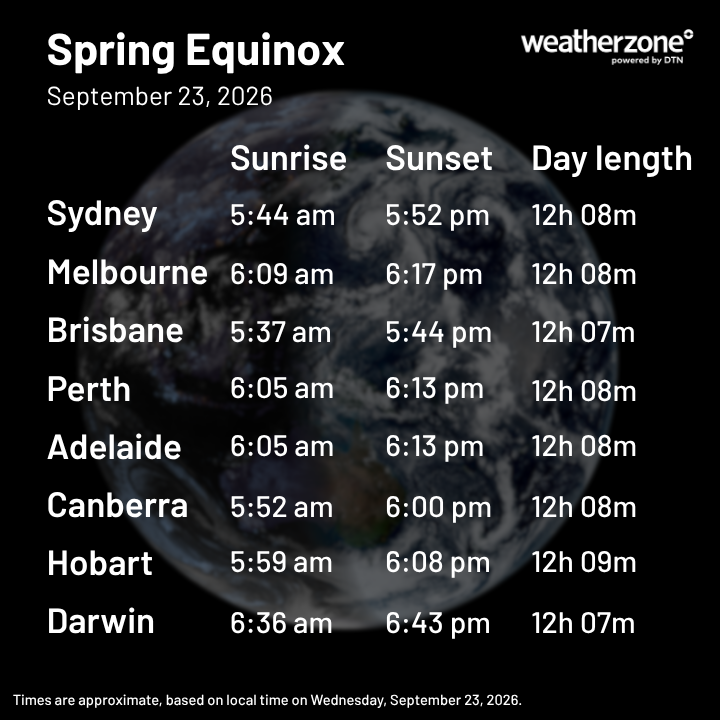
Image: Sunrise and sunset times on the date of the 2026 spring equinox. Source: Weatherzone.
Is the spring equinox the start of spring?
The September equinox marks the beginning of the astronomical spring in the Southern Hemisphere. This is around three weeks after the start of the meteorological spring, which commences at the beginning of September.
The astronomical seasons are based on Earth’s orbit around the Sun, and they use four key dates throughout the year to mark the beginning and end of each season. Summer and winter begin on the dates of the solstices in late December and late June, while autumn and spring start on the dates of the equinoxes in March and September.
Meteorological seasons run for three full calendar months, with the Southern Hemisphere seasons being:
- Summer: December – January – February
- Autumn: March – April – May
- Winter: June – July – August
- Spring: September – October – November
The astronomical and meteorological seasons are offset by about three weeks for several key reasons.
Meteorologists generally prefer not to use astronomical seasons because their dates vary from year to year. The start and end date of each astronomical season ranges from about 88 to 94 days. By contrast, the meteorological seasons are much more consistent, running for about 90 to 92 days.
The start and end dates of the astronomical seasons also change from year to year, while meteorological seasons always begin and end on the same dates, with the exception of a leap year.
Using calendar months to define the seasons also more closely matches natural seasonal temperature cycles in most parts of the world.
In short, astronomical seasons are useful for tracking changes in daylength and Earth’s position relative to the Sun. Meteorological seasons are more useful for defining the warmest and coldest periods of the year and comparing seasons historically.