
One million lightning pulses in outback Australia
A spectacular atmospheric light show illuminated the interior of Western Australia and parts of the Northern Territory and South Australia overnight, with more than one million lightning pulses detected in the 24 hours to 7 am (AWST) within 800 kilometres of Carnegie – a cattle station in WA's arid interior.
Significant 24-hour rainfall totals were recorded at several remote locations as rain and storms accompanied the lightning flashes.
What caused the storms and lightning?
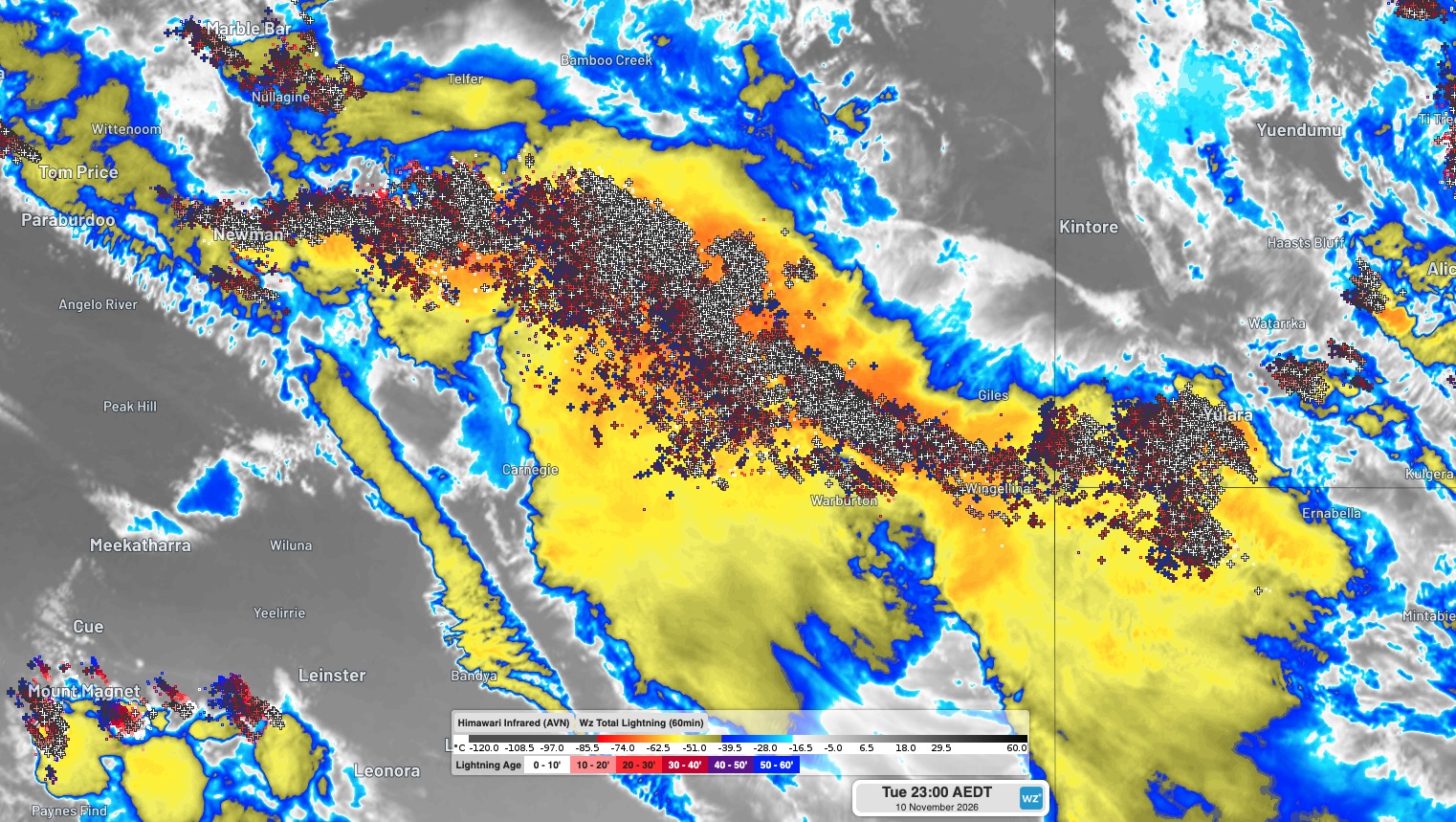
Image: Lightning strikes at 11 pm (AEDT) over parts of interior WA, NT and SA. Source: Weatherzone.
A broad area of low pressure is centred over WA's Gascoyne region with a series of upper and lower level troughs extending into the interior of the state.
A moisture feed from unusually warm waters in the Indian Ocean combined with hot temperatures on Tuesday afternoon to enhance the atmospheric instability.
How much rainfall was recorded?
Notable WA observations:
Unusually heavy rainfall for this time of year was recorded at several locations in the Gascoyne region, including 40.0 mm at Mount Magnet Airport and 32.8 mm at Golden Grove, a mine about 500 km northeast of Perth.
During thunderstorm outbreaks, the bulk of a daily rainfall total often occurs in a short period, and that was the case at Mount Magnet, with 25 mm falling in half an hour between 4 pm and 5 pm.
Much further east, the weather station at Giles on the edge of the Gibson Desert reported 29.6 mm, while 23 mm fell at West Musgrave Airport near the intersection of the NT, WA and SA borders.
Notable NT observations:
Numerous locations around Alice Springs received around 20 mm of rain, including Alice Springs Airport with 17.2 mm.
About 200 kilometres north of The Alice on the northern edge of the Simpson Desert, the Territory Grape Farm received 27.4 mm.
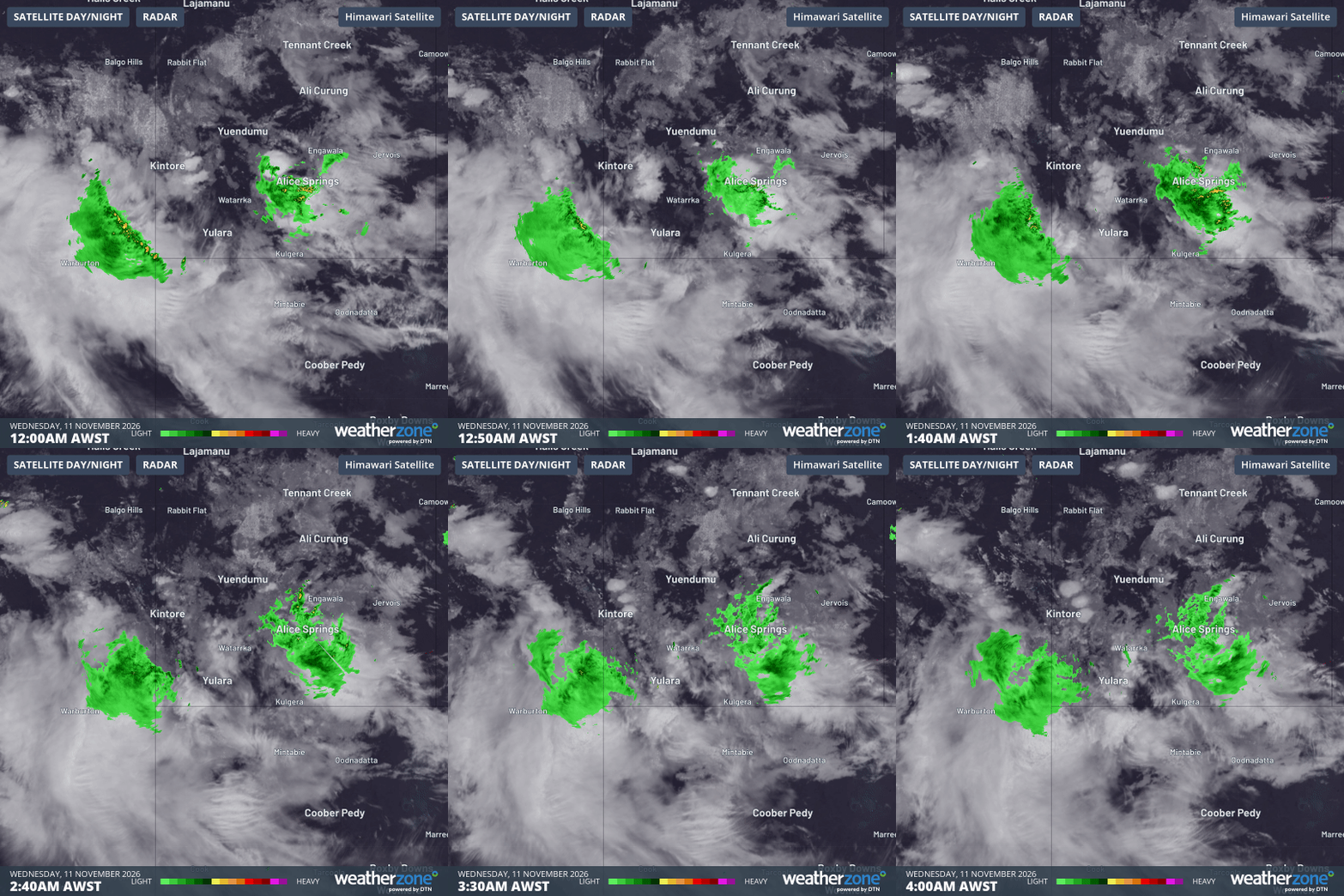
Image: Radar and satellite loop for the four hours to 4 am (AWST) on Wednesday, November 11, 2026, showing areas of rain near Giles in eastern WA and Alice Springs in the southern NT. Source: Weatherzone.
It should also be noted that strong wind gusts were a feature of the overnight storms, with a late afternoon gust of 96 km/h at Ironbridge Mine Airport in WA's Pilbara region, and a gust of 87 km/h at Yulara Airport, near Uluru.
Will this stormy outbreak continue?
Widespread storms are likely for at least another day or two of in parts of Australia's interior, as the current synoptic pattern is relatively slow-moving. Early indications are that a second burst of stormy weather could develop across Australia's interior early next week.
Perth has very much missed out on any rain so far from this (mostly) inland event, however storms could make it as far south as the WA capital next Monday.
The difference between a lightning pulse and a lightning strike
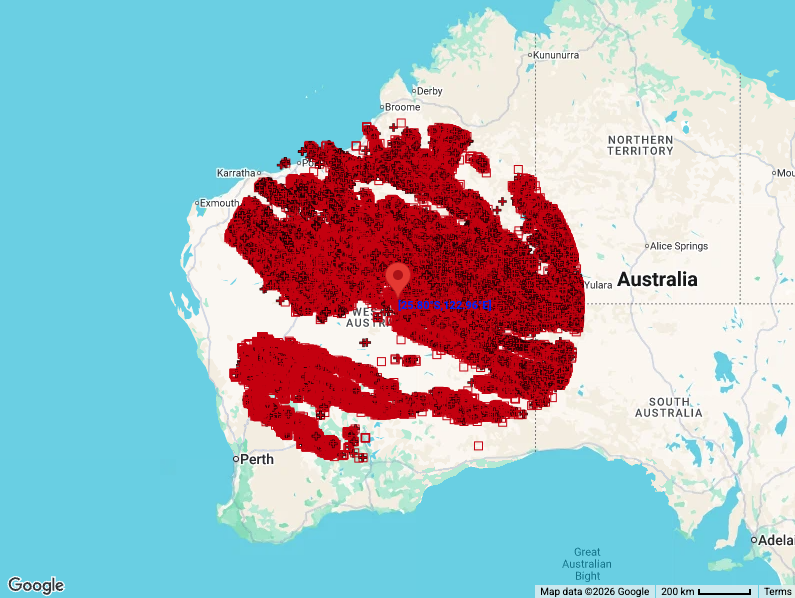
Image: Lightning pulses within 800 km of Giles, WA, in the 24 hours to 7 am (AWST) on Wednesday, November 11, 2026. Source: Weatherzone.
A lightning flash (or strike) is made up of multiple pulses along the conductive channel.
So for example, there were 493,267 lightning flashes in the 24 hours to 7am (AWST) this Wednesday across the whole of WA and the NT combined. These flashes caused 1,328,097 lightning pulses.
Of those 1,328,097 lightning pulses, a total of 1,000,380 were recorded within 800 km of Carnegie, WA, during the 24 hours to 7 am AWST this Wednesday.