
Increased summer bushfire risk cross parts of six Australian states and territories
This summer is expected to have an increased risk of bush and grass fires in parts of six Australian states and territories, as increased fire fuel loads combine with abnormally high temperatures under the ongoing influence of El Niño.
The Australian Fire and Emergency Service Authorities Council (AFAC) released the seasonal bushfire outlook for summer 2026–27 on Friday.
According to the outlook, parts of NSW, Victoria, SA, Tasmania, WA and the NT have an increased risk of fire this summer. This means there is an elevated likelihood of conditions conducive to an increased number of significant bushfires occurring this summer compared to the average risk.
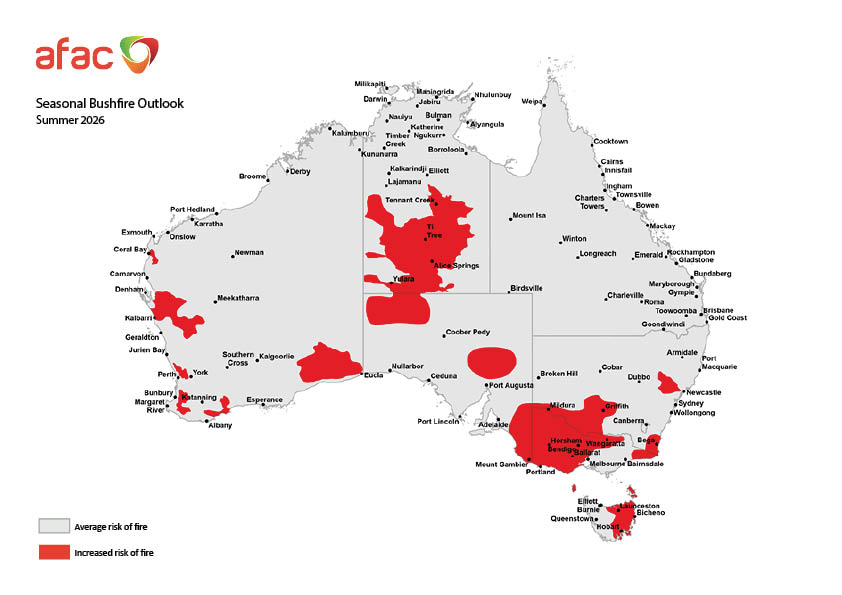
Image: Summer 2026 bushfire outlook. Source: AFAC.
A range of influences can affect seasonal fire risk. This summer’s elevated fire risk is mainly being driven by lower-than-average soil moisture, elevated fuel loads (dry vegetation) and forecast dry and hot conditions in the coming months.
Rainfall in the leadup to this summer has been well below average in parts of southeastern and southwestern Australia. These rainfall deficiencies will be difficult to overcome this summer. As a result, forested areas that contain significant amounts of vegetation in these dry regions may have dense fuel loads that could support intense fire activity.
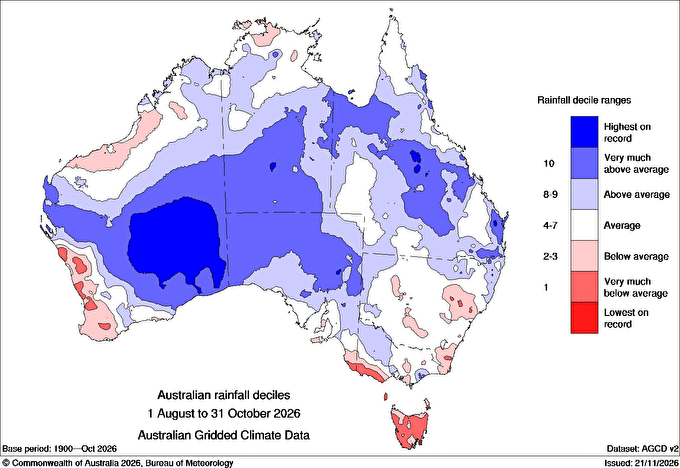
Image: Three-month rainfall deciles for the August–September–October period in 2026. Red shading shows where rainfall was below average during this period.
In NSW for example, the AFAC predicts an increased risk of bush fire in parts of the Hunter and southeast NSW. Longer-term rainfall deficiencies combined with existing dense vegetation could lead to abundant fuel that can support intense fire activity in these areas this summer.
The AFAC outlook also highlights Victoria as an area to watch this summer. A wet October across much of the state has caused extreme grass and crop growth in the north and west. This will bring increased grass fire potential once this grass cures in December and January. Forest fires are also expected to become an increasing risk in the state’s southwest and East Gippsland this summer, particularly from January onwards as higher temperatures dry out the vegetation and ground.
Tasmania has experienced an unusually warm and dry year to date, particularly in the eastern half of the state. These conditions will elevate the risk of fires this summer, with dry vegetation and rising temperatures possibly supporting intense fire behaviour this season.
Large areas of central Australia and parts of WA are expected to see elevated fire risk this summer. In central Australia, this is mainly due to a dry and warm outlook for the season ahead. In WA, a combination of abundant vegetation and below-average winter rainfall in some areas will cause pockets of enhanced fire risk over the state’s south and west this summer.
One factor contributing to this summer’s warm and dry outlook is El Niño, which is expected to persist throughout the season. While El Niño’s influence on Australia's weather typically wanes in summer, it still increases the likelihood of below average rainfall and above average maximum temperatures over southeastern Australia between December and January.
It is also important to point out that bush and grass fires are still possible in areas that have an average risk of fires this summer. So, while Queensland and the ACT do not have an increased risk of fires this season, normal seasonal fire activity may still occur.