
First tropical cyclone of Australia's 2026–27 season could form this week
The Bureau of Meteorology says there is a moderate risk that the first tropical cyclone of Australia’s 2026–27 cyclone season will develop by this weekend.
Satellite images captured on Tuesday morning show an area of convective clouds located over the eastern Indian Ocean roughly 1000 km to the northwest of the Cocos (Keeling) Islands. This cloud mass shows a budding area of low pressure that could be the seed for a tropical cyclone later this week.
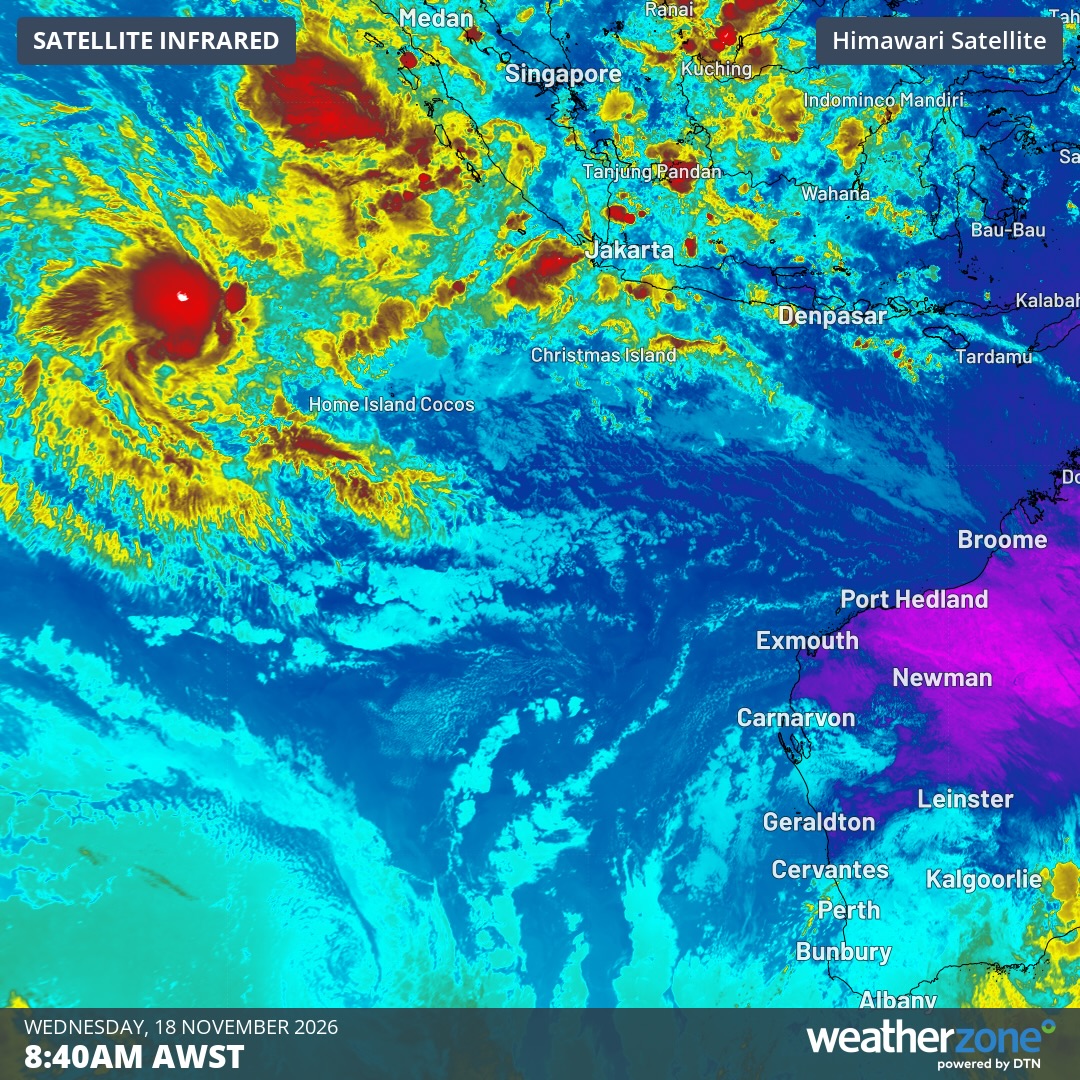
Image: Enhanced infrared satellite image showing clouds associated with a developing low pressure system to the northwest of the Cocos (Keeling) Islands. Source: Weatherzone.
The developing tropical low is currently sitting over an area of the Indian Ocean where sea surface temperatures are about 28°C. This is comfortably above the 26.5°C temperature threshold required for tropical cyclone formation.
According to the Bureau, the tropical low has a moderate chance (25% likelihood) of strengthening into a tropical cyclone on Friday or Saturday as it tracks towards the southeast. Conditions will then become less favourable from Sunday, reducing the likelihood of it becoming or remaining a tropical cyclone into next week.
At this stage, the system is not likely to directly impact the Cocos (Keeling) Islands or mainland Australia. If it does become a tropical cyclone inside Australia's area of responsibility, it will be named Owen.
While it has been around seven months since a tropical cyclone has been active near the Australian region, it’s not unusual to see cyclone development starting to occur at this time of year. November is the first month of Australia’s tropical cyclone season, which runs for six months and ends in April. Last year, the first cyclone of the season – Fina – developed on November 18.
You can keep track of tropical cyclones in the Australian region by checking the Bureau of Meteorology’s latest tropical cyclone outlooks and advisories throughout the season.